
Church calendar
SUpport us

(God, we praise thee now in the stillness) for soprano, alto, tenor and bass, vocal ensemble, trumpet I-III, timpani, oboe I+II, strings and basso continuo
(God, we praise thee now in the stillness) for soprano, alto, tenor and bass, vocal ensemble, trumpet I-III, timpani, oboe I+II, strings and basso continuo
Soprano
Miriam Feuersinger
Alto
Jan Börner
Tenor
Sören Richter
Bass
Daniel Pérez
Soprano
Alice Borciani, Susanne Seitter, Noëmi Sohn Nad, Noëmi Tran-Rediger, Baiba Urka, Mirjam Wernli
Alto
Antonia Frey, Katharina Guglhör, Lea Pfister-Scherer, Simon Savoy, Lisa Weiss
Tenor
Clemens Flämig, Manuel Gerber, Christian Rathgeber, Sören Richter
Bass
Fabrice Hayoz, Serafin Heusser, Johannes Hill, Daniel Pérez, Tobias Wicky
Conductor
Rudolf Lutz
Violin
Renate Steinmann, Olivia Schenkel, Patricia Do, Elisabeth Kohler, Marita Seeger, Salome Zimmermann
Viola
Susanna Hefti, Claire Foltzer, Stella Mahrenholz
Violoncello
Martin Zeller, Hristo Kouzmanov
Violone
Markus Bernhard
Trumpet
Lukasz Gothszalk, Bruno Fernandes, Alexander Samawicz
Timpani
Laurent de Ceuninck
Oboe
Linda Alijaj, Laura Alvarado
Bassoon
Susann Landert
Harpsichord
Thomas Leininger
Organ
Nicola Cumer
Participants
Rudolf Lutz, Pfr. Niklaus Peter
Speaker
Hermann Hess
Recording date
29/10/2021
Recording location
St. Gallen (Switzerland) // Olma-Halle 2.0
Sound engineer
Stefan Ritzenthaler
Producer
Meinrad Keel
Executive producer
Johannes Widmer
Production
GALLUS MEDIA AG, Schweiz
Producer
J.S. Bach-Stiftung, St. Gallen, Schweiz
First performance
First version probably in 1729, later version in 1742 later – Leipzig
Text
Psalm 65:2 (movement 1); unknown source (movements 2–5), Martin Luther (movement 6)
1. Arie — Alt
«Gott, man lobet dich in der Stille zu Zion, und dir bezahlet man Gelübde».
2. Chor
Jauchzet, ihr erfreuten Stimmen,
steiget bis zum Himmel ‘nauf!
Lobet Gott im Heiligtum
und erhebet seinen Ruhm;
seine Güte,
sein erbarmendes Gemüte
hört zu keinen Zeiten auf.
3. Rezitativ — Bass
Auf! du geliebte Lindenstadt,
komm, falle vor dem Höchsten nieder;
erkenne, wie er dich
in deinem Schmuck und Pracht
so väterlich
erhält, beschützt, bewacht
und seine Liebeshand
noch über dir beständig hat.
Wohlan,
bezahle die Gelübde, die du dem Höchsten hast getan,
und singe Dank- und Demutslieder;
komm, bitte, daß er Stadt und Land
unendlich wolle mehr erquicken
und diese werte Obrigkeit,
so heute Sitz und Wahl verneut,
mit vielem Segen wolle schmücken.
4. Arie — Sopran
Heil und Segen
soll und muß zu aller Zeit
sich auf unsre Obrigkeit
in erwünschter Fülle legen,
daß sich Recht und Treue müssen
miteinander freundlich küssen.
5. Rezitativ — Tenor
Nun, Herr, so weihe selbst das Regiment mit deinem Segen ein,
daß alle Bosheit von uns fliehe
und die Gerechtigkeit in unsern Hütten blühe,
daß deines Vaters reiner Same
und dein gebenedeiter Name
bei uns verherrlicht möge sein.
6. Choral
Nun hilf uns, Herr, den Dienern dein,
die mit dein’m Blut erlöset sein;
laß uns im Himmel haben Teil
mit den Heilgen im ewgen Heil.
Hilf deinem Volk, Herr Jesu Christ,
und segne, was dein Erbteil ist;
wart und pfleg ihr’ zu aller Zeit
und heb sie hoch in Ewigkeit.

All libretti sourced from Neue Bach-Ausgabe. Johann Sebastian Bach. Neue Ausgabe sämtlicher Werke, published by the Johann-Sebastian-Bach-Institut Göttingen and the Bach-Archiv Leipzig, Series I (Cantatas), vol. 1–41, Kassel and Leipzig, 1954–2000.
All in-depth analyses by Anselm Hartinger (English translations/editing by Alice Noger-Gradon/Mary Carozza) based on the following sources: Hans-Joachim Schulze, Die Bach-Kantaten. Einführungen zu sämtlichen Kantaten Johann Sebastian Bachs, Leipzig, 2nd edition, 2007; Alfred Dürr, Johann Sebastian Bach. Die Kantaten, Kassel, 9th edition, 2009, and Martin Petzoldt, Bach-Kommentar. Die geistlichen Kantaten, Stuttgart, vol. 1, 2nd edition, 2005 and vol. 2, 1st edition, 2007.
Alle Kantatentexte stammen aus «Neue Bach-Ausgabe. Johann Sebastian Bach. Neue Ausgabe sämtlicher Werke», herausgegeben vom Johann-Sebastian-Bach-Institut Göttingen und vom Bach-Archiv Leipzig, Serie I (Kantaten), Bd. 1–41, Kassel und Leipzig, 1954–2000.
Alle einführenden Texte zu den Werken, die Texte «Vertiefte Auseinandersetzung mit dem Werk» sowie die «musikalisch-theologische Anmerkungen» wurden von Anselm Hartinger und Pfr. Niklaus Peter sowie Pfr. Karl Graf verfasst unter Bezug auf die Referenzwerke: Hans-Joachim Schulze, «Die Bach-Kantaten. Einführungen zu sämtlichen Kantaten Johann Sebastian Bachs», Leipzig, 2. Aufl. 2007; Alfred Dürr, «Johann Sebastian Bach. Die Kantaten», Kassel, 9. Aufl. 2009, und Martin Petzoldt, «Bach-Kommentar. Die geistlichen Kantaten», Stuttgart, Bd. 1, 2. Aufl. 2005 und Bd. 2, 1. Aufl. 2007.
for soprano, alto, tenor and bass, vocal ensemble, trumpet I-III, timpani, oboe I + II, strings and basso continuo.
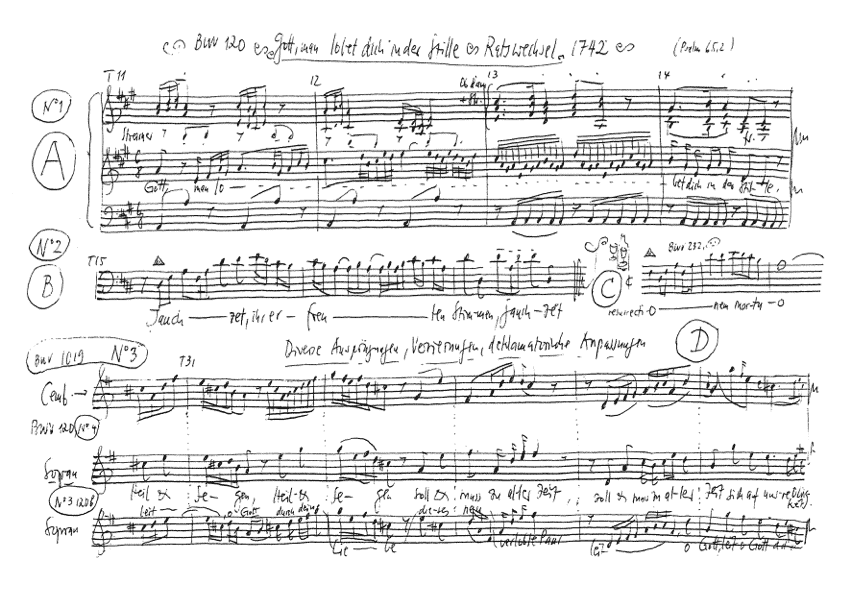
The annual exchange of councillors on St Bartholomew’s Day (24 August) in Leipzig’s Nikolai Church was the climax of the municipal representation of power and meant an honourable additional task for Bach as municipal director musices. For this reason, his Ratswechsel music is characterised by high quality and large instrumentation; the cantata BWV 120, which emerged from a protracted genesis and was performed again several times until the 1740s, deviates from this only in that it translated the contrast of “silence” and “rejoicing” into the sequence of a restrained, pulsating opening aria and a tutti chorus following it, which Bach later extensively revised for the “Etexpecto” of his B minor Mass. The enchanting soprano aria “Heil und Segen” (Salvation and Blessing) shows that it was rededicated to wedding music in the meantime; moreover, Bach, who was himself an outstanding violinist, also left it as a sonata movement for violin and harpsichord.
This text has been translated with DeepL (www.deepl.com).
Further study
The Leipzig of Bach’s day was not an independent republic, but a city belonging to the Electorate of Saxony, and it was the territorial sovereign who ultimately bore responsibility for the city’s fate and appointed its leaders. In deference to Leipzig’s significance as a trade fair city, however, an effort was made to elevate its status through symbolic acts, thus creating an appearance of self-administration, and to include as many Patrician families in the city leadership as possible. One such effort was the annual rotation of the three city councils, when one of the two “passive” councils became the “sitting” council that officially ruled the city. The inauguration took place each year in the St Nikolai church on the feast day of Bartholomew, and composing the figural music for these occasions was one of Bach’s loftiest (and best-paid) obligations in Leipzig; as such, his five council election cantatas number among his most splendidsounding compositions. BWV 120 is the result of a long and complex genesis and is derived from earlier occasional works – weddings, for instance, as well as the bicentenary of the Augsburg Confession in 1730 – with the surviving version not having been performed before 1742.
Through its scoring for an alto soloist and two oboes d’amore, the introductory movement set in the radiant key of A major exudes a tender aura that complements the sensitive rendering of the key word “Stille” (stillness). As such, the surprisingly subdued nature of the movement is an apt tonal interpretation of the heightening drama in the libretto, with its compilation of psalm text and freely versed additions; in this setting, the energy manifest in the vocal and oboe coloraturas foreshadows the impending musical eruption. In the ensuing D major chorus, replete with magnificent trumpets, the musical machinery shifts into high gear. Here, the alternating fanfares and imitative figures prepare a grand stage for the “Jauchzen” (rejoicing) of the “erfreuten Stimmen” (joyous voices), while the fugal episodes interspersed throughout the lively rondo ascend heavenwards, akin to the smoke of burnt offerings. That Bach evidently valued this exuberant chorus of praise is seen in its reuse towards the end of his life for the “Et expecto resurrectionem mortuorum” movement of his B Minor Mass. In this later work, however, he omitted the more compact middle section set to the words of “Lobet Gott im Heiligtum” (Praise God in his holy shrine) – and with it a section of text that demonstratively raised the St Nikolai church of Leipzig to the new temple of an ideal commune fashioned as the divine city of Jerusalem.
The bass recitative expands on these references, and, in doing so, makes mention of the “Lindenstadt” (lindentown, an etymologically false but well-established interpretation of the name “Leipzig”), the reciprocal relationship between humble thanks and fatherly protection, and the council election procedure itself. In solemn tones, the soloist at once invokes communal unity and the hierarchy of its governors in both this world and the next.
In several of Bach’s council election cantatas, such reminders of governance fundamentals are followed by a personal reflection that presents the blessings of the new leadership as the tangible reason for a general sense of wellbeing. This notion is expressed with nigh unmatched poignancy in the lilting 6⁄8 – time soprano aria “Heil und Segen” (health and blessing), in which Bach most fittingly revived some material from a work praising the marriage union (“Leit, o Gott, durch deine Liebe” – Lead, O God, through thy love’s kindness – BWV 120a/3). Featuring a sparkling violin concertino part, the setting is also related to an early version of the sonata in G major for harpsichord and violin BWV 1019a, and in this new reworking, Bach’s experience as a violinist, virtuoso keyboardist, composer and arranger melds in music of divine elegance. Indeed, rarely have theory of the state and social cohesion been extolled with such fervency as in the setting of the psalm line “daß sich Recht und Treue müssen freundlich miteinander küssen” (so that faith and justice shall be led as friends to kiss each other). Perhaps in our modern times of mediatised conflict, we too would benefit from similar ceremonies engendering communal spirit.
Accompanied by strings, the tenor recitative forcefully pleads “daß alle Bosheit von uns fliehe und die Gerechtigkeit in unsern Hütten blühe” (that every malice may flee from us, and that true righteousness within our dwellings flourish). The reference to the divine obligations of all governments would no doubt have flowed easily enough from Bach’s pen, especially if we bear in mind that not all dignitaries seated on St. Nikolai’s council pew were well-inclined towards the city music director, who was generally considered too headstrong for his own good.
In the closing chorale, which is based on Martin Luther’s German “Te Deum”, all earthly splendour yields to an internalised prayer that consistently considers the Christian community in the context of the afterlife, a timeless message that is reflected in the archaic tone of the old Gregorian chant. In our recording, this introspective setting is followed by an intrada for brass instruments composed by Thomas Leininger using material from the introductory chorus. This addition underscores the representative nature of the inauguration church service while serving as a nod to both the Marcia section of cantata BWV 207 and the closing fanfares of the council election cantata BWV 69.
Show commitment
Support the Bachipedia project as a donor - for the dissemination of Bach's vocal works worldwide, in order to make the work accessible to young people in particular. Thank you very much!
Support